Frankenstein (1931)
Click on the image for clarity.
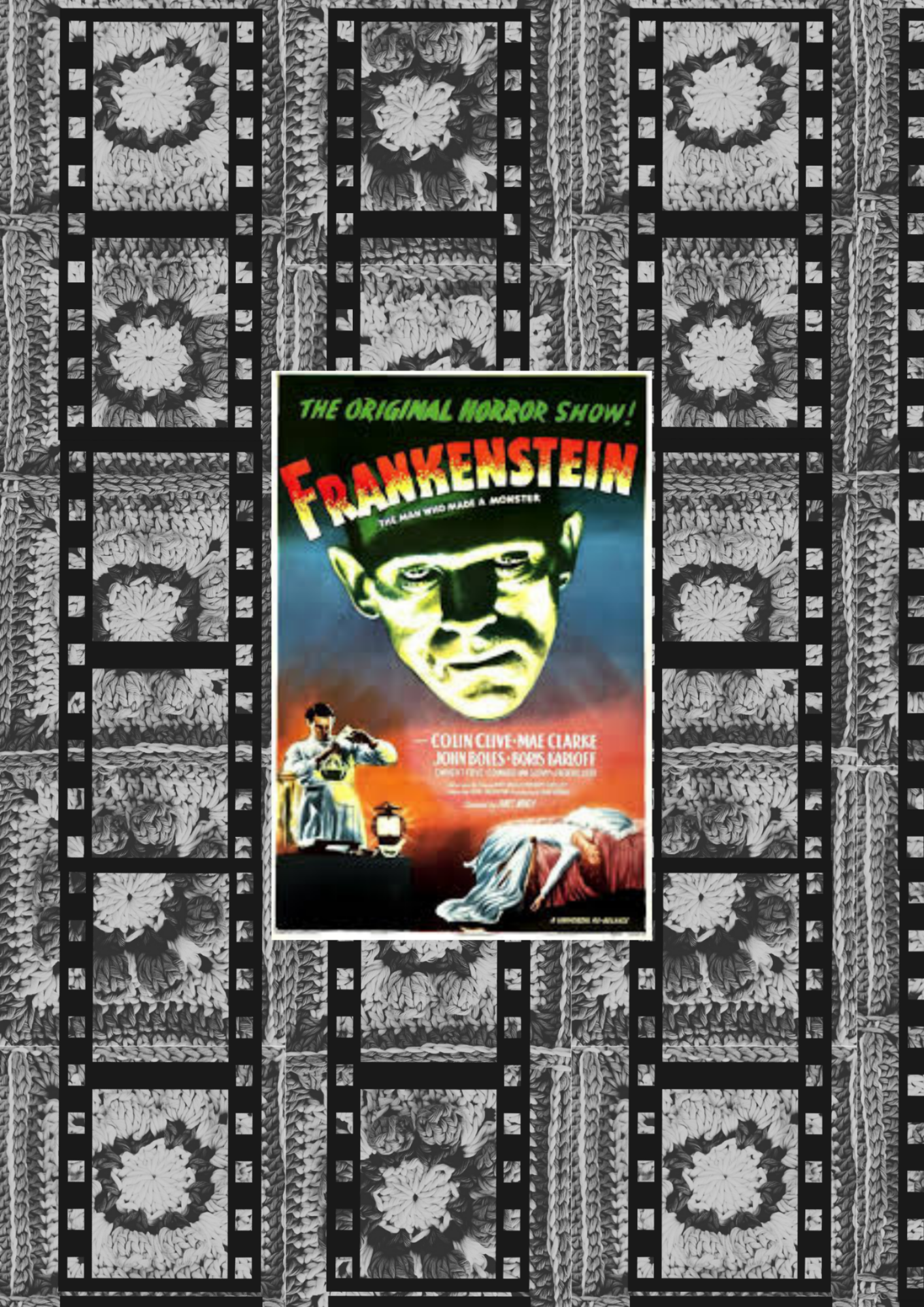
Recollection on the beginnings of my craft
Below is a transcription of an old piece of writing
Shortly after my first encounter with a representation of myself, or of “Frankenstein,” I found myself one night in an alleyway mulling over my notes on the picture. That is when I saw an older woman being followed by a strange man. For a second, I wanted to turn and run away as I did not want the trouble of human matters. But part of me kept thinking of how the monster in the movie generated a fear response, the ability to make men run away. Could this fear not be used to help this woman? I took off my thin disguise and straightened myself to my full height and width. I did not run, I approached with the quiet confidence of someone who did not need to boast their power. The man turned his back on whatever nefarious act he was willing to commit, but the woman did not react to my appearance.
I calmly greeted her as she got closer, and she sighed with relief saying that she had gotten lost and if I could take her back to her home in South End. Sonia was around 60 when I first met her, and her eyesight was impaired, making even a squint somewhat blurry. Therefore, she spent most of her time in her apartment, which doubled as a shoemaking business, working or praying. She used to have two employees helping her make a range of shoes, but in recent years those workers opted for the factories. She had a family, but after her husband died she decided to move to the United States to follow her only child to college. Her child grew up and moved to New York City. Rather than go back to a place with only the memory of her husband, she decided to live alone, making due with her skills and the neighbors she had come to know. She admitted to me that night that she had been lonely. She could tell I was lonely, too, by the way I kept hesitating at every small kindness she extended towards me. I asked her what she did when she felt too lonely, remembering the pull of the sea underneath me. She responded that there was no cure, even sometimes around other people she could feel lonely because no one understood her pain, but making something with her own hands felt like a small act of control.
Therefore, I stayed with her and received a modest paycheck in exchange for regularly cleaning the apartment, helping with her shoemaking business, and reading her stories at night. It was a quiet life. I worked during the day, cutting, plastering, and sewing in the back room. Helda did not mind that I never wanted to step out and greet the customers and neighbors. With the money, I would go back to the theater as I pleased, under the cover of night. The Frankenstein movie of 1910 was “lost” due to the studios mishandling of the nitrate film’s storage, so I did not have to see the picture ever again. I had learned that the movie was based on a 1818 novel written by Mary Shelley of the same name. Damn that Captain Walton for his letters exposed the beats of my life. I was a bit surprised, though, since the novel consists of Shelley’s crafting of Walton’s retelling of Frankenstein’s retelling, yet my personal insights and emotions shone through with quiet reassurance that what I saw in 1910 was not the true story. I was not just a fragment or a frightening object lurching around in the world. I will admit, seeing Frankenstein’s early life before me was a shock in thinking of him as anything other than my cruel creator. Yet he gave me this never ending life with no love, no family, no history. How much more cruel could a man be?
One night, I wanted to see what Sonia’s thoughts would be on the novel, so I started a few chapters, yet sometimes my breath would hitch, overwhelmed with the lines of a backstory I had just learned. Sonia had noticed my wavering voice and quietly handed me some yarn and a hook. I was confused until she demonstrated to me the calming practice of crochet. She did not need to tell me why, all she did was demonstrate new patterns each night, and the only words she spoke were those of small prayers in her first language, a language she kept hidden unless it was in the intimacy of the night. Her prayers were the rare glimpses I had of her past life before I met her in that alleyway. I also found the creation of crochet patterns to be as soft and beautiful as those nights together. In fact, when the Great War broke out, I even contributed a few crochet blankets and socks to the effort, through Sonia’s name and face, of course.
That is why when I saw news in 1931 that a new Frankenstein picture was going to be shown, directed by James Whale, I brought my hook and yarn to calm my emotions that would boil over. The picture was significantly longer than the 1910 version, and the narrative and my characterization was quite different. In this story, Frankenstein is like a mad man, a mad scientist, who goes grave robbing with an assistant, Fritz. His fiancee, Elizabeth, is worried about him, and so with a friend, visits Frankenstein as he is about to bring to life his monster/me through lightning. Frankenstein proclaims, “It’s alive. It’s alive. It’s alive. It’s alive. It’s ALIVE! In the name of God. Now I know what it feels like to be God!” I knew I could never tell Sonia about this movie because she would decree it blasphemous. Nevertheless, the “it” is hardly all of Frankenstein’s hopes and dreams because, even though the creature moves toward the rays of the sun like a sunflower, when faced with fire, he reacts negatively, causing Frankenstein and the others to try to subdue him.
There is something soft about the monster. Despite him having murdered three people in the movie, two out of self defense and one in an accidental drowning, his actions are that of a child that happens to be in a large, makeshift body. I wonder if that is how I would have been interpreted before I had watched and learned from the De Lacey’s in their home. Did I also look at flowers with delight? Did I also have the capability to kill before it was to seek revenge? Although I could not say whether I thought of myself as that creature, I empathized with him, wanting him to find a way out of that windmill. At the end of the screening, I ended up making a granny square with flowers to represent him. I vow to never stop making them every time I watch another version of my/his story. For while the House of Frankenstein prevails, my readings can also live on in the stitching, loops, binds.


Leave a comment