El Superloco! (1937)
Click on the image for clarity.
Sometime in 2026
James Whale’s rendition of the Frankenstein story proved to be iconic, especially his depiction of me as massive, with a flat top head, and, once color became more prevalent in film, green. Although I would not call myself a beauty queen in any sense of the word, I scoff at the green. Sickly? Sure. Lifeless lips? I am definitely not kissing anyone. Big forehead? I like to joke that it is the only suitable place to keep my big brain. But green is just offensive, and I am not even talking about the bolts on my neck.
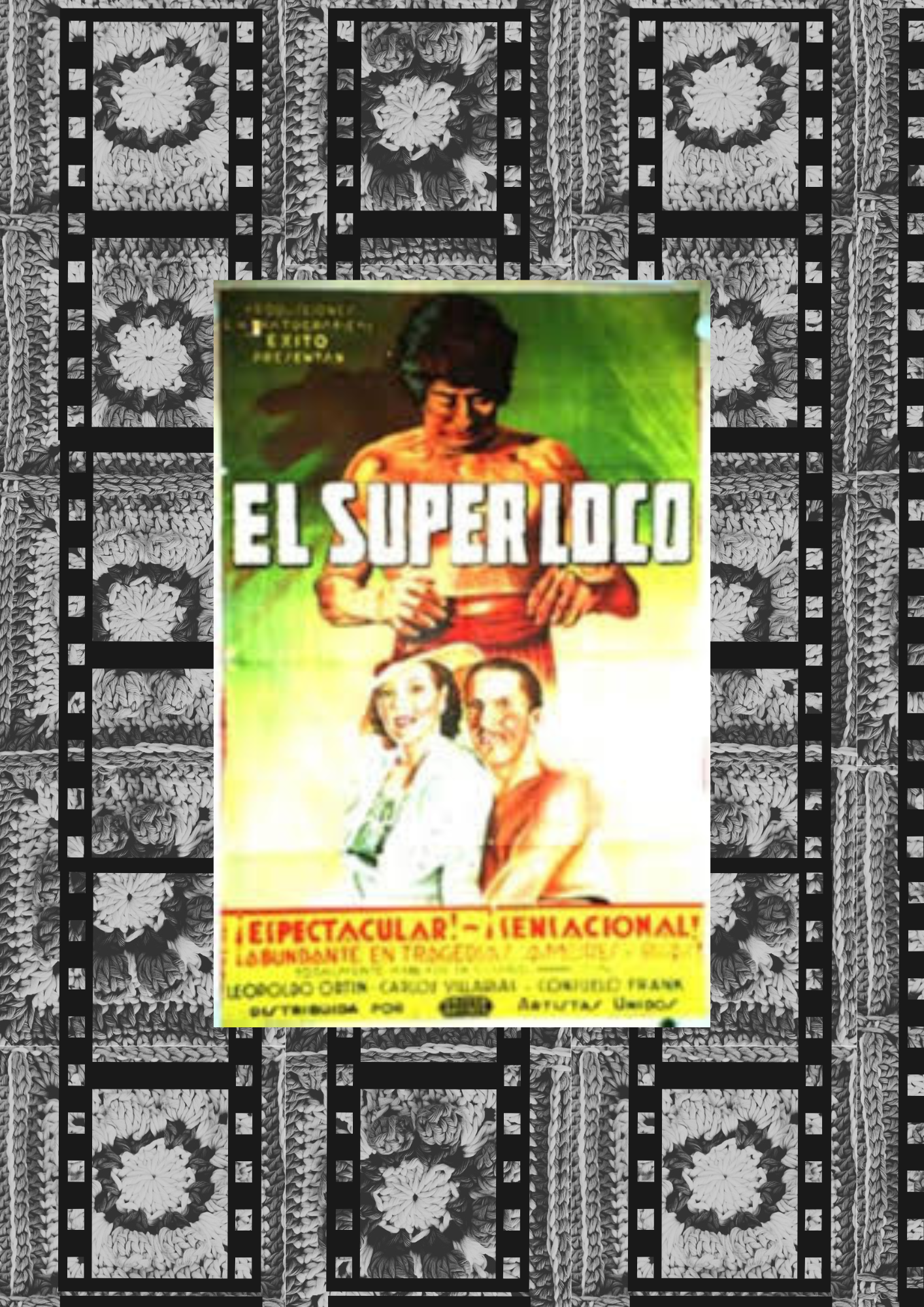
The case of any iconic work, like Shelley’s novel and Whale’s movie, is that their influence can lead to poor imitations. Yet at times even those imitations prove to be a capsule of ways in which I see not only myself bound to a trope, but also how others in this story are limited. Here I speak of the 1937 film El Superloco!, directed by Juan José Segura.
I had first heard Spanish from Sonia all those decades ago. When she died in 1942, she left me her apartment which at that point was located in a rapidly changing neighborhood after the second world war. Although I never felt comfortable stepping outside and letting anyone but Sonia get close to me, I could sit by the window and hear the cacophony of sounds, languages, cheers, greetings. I never really heard the language Sonia spoke, but there was something comforting about knowing the people around me were also coming from other parts of the world. Soon, the city began to disinvest in the area and my neighbors moved away. For a time I could get by with the money Sonia had left me, but I began to work at the docks at night, unloading cargo, and even took up a couple graveyard shifts at the manufacturing plant making microwaves and other household appliances. In these endeavours I kept to myself, and while I sometimes drew an inquisitive eye, most people just cared about getting the job done for their paycheck. My film excursions and thus my crocheting, dwindled during this time. Yet it was also an enlightening era since my workers and new neighbors spoke the language of Sonia. They had come from Puerto Rico and the Dominican Republic. I was delighted, a piece of Sonia lived and I wanted to learn.
Aunque no creo que hablo o escribo el español perfectamente, pude entender la película de este post. I was not there during the Mexican screenings of El Superloco!, but I did end up stumbling upon a digitized version of this Mexican film on YouTube. Sonia was not Mexican since after she died I found a few photos in a box at the back of her closet with Puerto Rico printed in the back and once she became a U.S. citizen, she proudly stated in the 1920s census that she was Spanish when asked for her color or race. Despite that, this was a version of my story I wish I could have shown her to see what she thought as it was interpreted for a different audience.
I was transfixed by the claims that this was a Mexican version of the Frankenstein story. Most of the movie centers around a young scientist, Dr. Alberto, and an older, eccentric scientist, Dr. Dienys. The latter has the belief that the power of will can defeat anything, including diseases and aging. The me in this story is confusing. He looks like a man, albeit one who probably works out way more than I do and looks ethnically distinct from the other characters due to a darker skin complexion and little clothing, just as Dr. Disneys’s assistant looks like an other in the story, different due to his turban. The monster is caged and asked to break a chain, but he cannot. Perhaps Dr. Dienys is trying to test the power of will? But it is not clear whether the monster has some inherently extraordinary ability. Maybe the fact that he looks different lends Dr. Dienys to think he has a certain strength, a primitive grounding that could make him break the chain.
The notion of a power of will reminds me of the debate of morality, of what should be shown for the virtue of society, occurring during the releases of these early 20th century films. Back in 1931, Whale’s movie was pushing the bounds of acceptability with many theaters requesting the censorship of portions of film such as Frankenstein’s declaration that he knows how it feels like to be God and the murder of the little girl, Maria. Three years later, the Hays Codes were enforced to rehabilitate the sexual scandals of the past film era. The Codes were meant to restrict film content that went against public decency such as interracial relationships or nudity, including proximate nudity by way of emphasizing silhouettes. Although Mexico did not have the Hays Code per say, the entertainment industries in the country had heavy censorship rules driven by religious, conservative groups. Could a power of will be defined as the prospect of finding ultimate virtue through acts of restraint? Therefore, does restraint come from a lack of temptation or does true restraint come from the test of temptation? Here, then we must define what temptation could look like. Would it be the dangers of modernity, like the happenings in my beloved Scollay Square, the drudge of my factory work, the creation of urban dwellings of people from all over? Was the monster seen as an example of the power of will if he were to come from a primitive past, unruffled by the above factors?
The idea that a power of will is a form of restraint to enact strength, which in the movie is about halting the aging process and breaking chains, is evidenced by Dr. Dienys’ deterioration once he falls for the “temptation” of Maria, Dr. Alberto’s fiance. Maria goes over to Dienys’ house looking for Alberto, and while they have had a flirtation throughout the movie, Dienys begins to sexually assault her, but when starting to cross her bodily boundaries, he begins to age, having lost his power of will. Yet an important critique to this movie logic is the idea that not assaulting someone is an act of restraint, an act that comes from the power of will. Even further, it is posited that Maria’s flirting and body can erode this power, a temptress.
At the same time, the monster is freed from the cage and seeks his revenge on Dineys, but because the monster also attacks the main characters, he is killed as well. Just like the creature from the 1931 film, the representations of me are shown as animalistic, beyond reason and therefore killed. They have characteristics that allude to power, such as brute force and perhaps the innocence of not knowing temptation, which again should be questioned in terms of what/who is temptation, but the monsters are ultimately discarded when they do not fit the model or pursuit of perfection. I end up contemplating on how Maria attempts to have power over her situation, by flirting as a form of investigation, but she is ultimately reduced as an object of desire. I decide that my granny squares will not be captured with a notion of perfection, the perfection that the Frankenstein archetype again and again attempts to find to the harm of everyone in the story. The granny squares should be represented in their gloom as well as their strength, their care as well as their binding, their beauty as well as their distortion.
3 responses to “1937 Movie”
-
How were you able to hide yourself in the factory?
LikeLike
-
I did everything I could to hunch over and avoid eye contact. I also wore a lot of layers to cover my skin. I am certain that I looked strange, but the graveyard shift does not raise a lot of questions.
LikeLike
-
-
I just posted my viewing experience on the 21st century page.
LikeLike


Leave a comment