Click on the images for clarity.
Turning to the digital and the ethical dilemmas behind my present-day depictions
Since the 80’s, I had to take up truck driving since many factory jobs were disappearing. I did not want to say goodbye to South End, so I put out an ad in the classified papers to rent out the apartment to other travelers for months at a time while I was away earning my keep. On the road, it was easy to keep to myself. I would spend my time in old movie theaters like the Texas Theater and Roxy Cinema, but once internet cafes were built in the 90s, I also frequented the late-night locations to read forums and chat rooms. I wanted to know more about how others viewed movies, admiring their critiques. I wanted to keep up with the politics of Boston, especially in the communities I have come to admire through their language and fight. Oftentimes I would even lurk in posted discussions over what it meant to give birth, how to deal with grief, when the world would end. Sometimes I would imagine if the world were to burn, would it finally be my funeral pyre or would space be my new sea. I never dared to type a private IM or add to a thread. Even then, I was more of an observer of human activity than part of the conversation. Eventually in the 2010s I obtained a remote job as a customer service representative, maintaining chats and customer calls, all from the safety of my home. With laptops and streaming services, I eventually stopped going to the movie theater. Less of a possibility to be perceived and hated. I had turned into a creature beyond purpose, watching over and over stories of humans I could never interact with and depictions of myself I loathed in different ways, now in a digitized form. I began to believe myself as stagnant, devoid of all feeling, even rage.
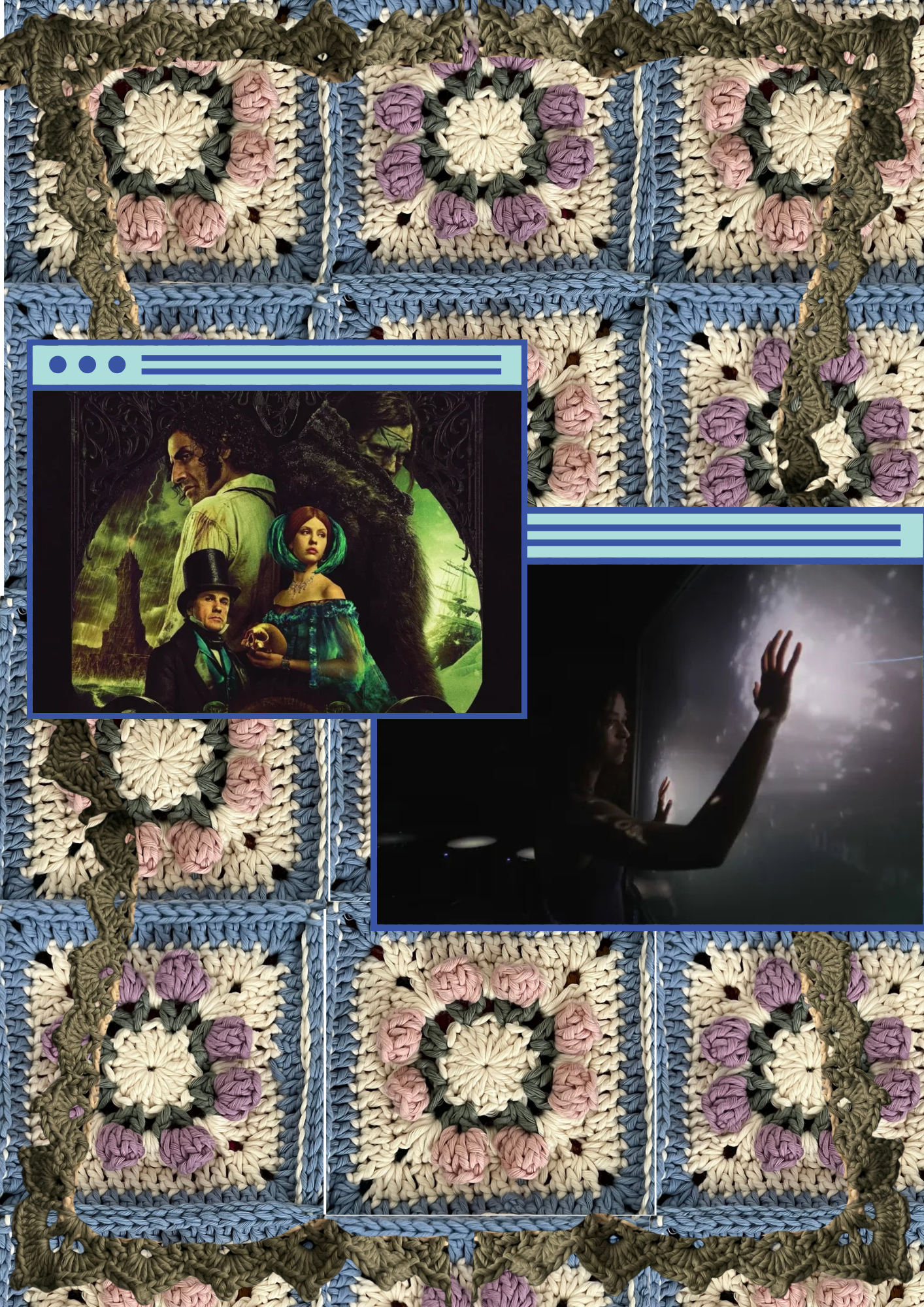
That was until I saw Guillermo del Toro’s Frankenstein this past year. As I had been doing recently, I nodded along to the familiar rhythm, noting down a change in character name, an exclusion of narrative strands, a twist to capture the attention of today’s viewers. For example, in this movie, Elizabeth is strong and not devoted to Frankenstein, and she has a tender relationship with me/the Creature. A part of me awakens, though, when the old De Lacy calls me his friend, bringing me back to the turmoil I felt in losing the family I used to seek. But it was also strangely satisfying to hear those words and seeing a tiny difference made to my narrative that reminded me that I had been known. As the story continued, I saw Elizabeth’s kindness, the strength of her care, and a wave of grief crashed over me for all that I have done and for all that I did not know at the time. What do I do with this knowledge and reckoning? But then the most drastic departure to my life, that of forgiveness, plays out between Frankenstein and myself. Rather than seeing my creator’s lifeless corpse, in the movie we speak to one another. While I think I/the Creature will hurt Frankenstein once more, Frankenstein gently places his hand over mine and the dialogue below ensues.
Victor: I am sorry. Regret consumes me. And I now regard my life for what it was
The Creature: You will go now creator. Fade away. It will all be but a brief moment. My birth. My grief. Your loss. I will not be punished. Nor absolved. What hope I had, what rage… it is all nothing. That tide that brought me here now comes to take you away. Leaving me stranded.
Victor: Forgive me. My son. And if you have it in your heart, forgive yourself into existence If death is not to be, then consider this, my son. While you are alive, what recourse do you have but to live?
I had to keep my hands steady as I put down my yarn and closed the laptop. I had not allowed myself to exist. The only time I had ever built beyond my past was with Sonia. The difference was not just her care and acceptance, but it was that I was willing to receive and know her, too. So I perused my old writings and projects that I had kept away. The newspaper scraps, the loose granny squares piling up, untethered from one another. I needed to remember what it meant to feel rage, but I also wanted to reconsume, reflect, and share all my bends and falls. I wanted to form a digital footprint to place myself in the conversations I have only seen from the outside. But I have never truly been on the outside. I have interpreted and soured and reminisced and, by all impossibility, even started to hope.
I have come to understand that I now have readers. One of you recently contacted me because you read a familiar name connected to a once-talked-about place your father’s father abandoned—Sonia Gomez. Your grandfather only kept pieces of Sonia, mainly photographs and a rosary, but you always wondered who she was and where she came from. We emailed and emailed. They were like letters and poems and late night crocheting, and I will always be grateful for your kindness. We spoke of my past and the troubles I am beginning to confront within myself and with others, you spoke of your life as a third-generation American and the difficulties you have with understanding your Puerto Rican heritage. Throughout your years, you have tried to mobilize for your communities, to not let injustice look like a norm. Currently, you have been working to stop the further construction of AI data centers.
When you mentioned AI, I immediately thought of the project “Frankenstein AI” led by Rachel Ginsberg, which another reader sent to me wondering my thoughts on AI since my story is called upon multiple times in discussing the fear of creating other life forms. This project takes up the story of Prometheus and Mary Shelley’s Frankenstein to think of what it means for humans to contend with and/or ignore their own responsibility in creating artificial intelligence since machine learning travels and scrapes the fragments of their data across the internet. As Ginsberg explains, the collaborative project of Frankenstein AI has people and the AI interact with each other, in which the technology observes and connects directly with the humans rather than just the vacuum of the internet. Frankenstein AI goes from rage to connectivity.
Yet as Anne Pasek states in her article “AI is Trash” we must be careful in understanding that AI can conglomerate different technologies, a purposeful confusion that also renders government and corporate responsibility null and void, forgotten because of amplified fears of the idea of AI and the blame placed on individuals for using such platforms. As Sonia’s great-granddaughter taught me, AI like chatGPT requires extensive energy that can heavily drain and deplete resources like water and fossil fuels. Therefore, local communities surrounding these data centers are facing environmental and noise pollution. Activist organizations have been opposing the building of more centers, including recent debate in Boston. Even if “AI” is already present and could be mediated by further human interactions, what would be the cost? If I follow the analogy, though, is this line of questioning similar to the fears my creator had of me? Alive yet a potential danger. Realistically, the analogy only goes so far as I do not require a mass amount of energy (that was only necessary for my birth).
As if AI as a buzzword and as a generator is not ubiquitous enough, I fear my remote job is now in danger of being automated. The accumulation of my reflections on forgiveness, healing, connection, and mobilization have led me to want more, to demand more, to state that I am here. What world will I continue to live in? What world will we continue to live in?


Leave a comment